I.
Before the trouser
For much of European history, a fashionable man did not wear long trousers at all. Through the seventeenth and eighteenth centuries, the dress of the upper classes centred on knee breeches: close-fitting garments that fastened just below the knee and were worn with stockings and buckled shoes. Breeches showed off a well-turned calf, and they signalled a life lived largely without manual labour.
Long, loose trousers existed, but they belonged to other worlds: to sailors, labourers and working people, for whom practicality mattered more than display. The idea that a gentleman's formal dress would one day be built around that humble garment would have seemed unlikely.
II.
A garment of revolution
The change began, in part, as a political statement. During the French Revolution in the 1790s, radical working-class supporters became known as the sans-culottes, literally "without breeches", because they wore long trousers rather than the silk culottes associated with the aristocracy. Clothing became a visible marker of allegiance.
Across Europe, the decades that followed saw a broader move away from aristocratic display toward simpler, more practical dress. Long trousers and close-fitting pantaloons moved steadily from the margins of fashion toward its centre.
The history of the trouser is a history of practicality slowly becoming elegance.
III.
The rise of tailoring
In early nineteenth-century Britain, a new ideal of men's dress emerged that valued cut, fit and restraint over ornament. George "Beau" Brummell, the Regency-era arbiter of taste, is closely associated with this shift: dark, well-cut coats, immaculate linen and close-fitting pantaloons or trousers, worn with studied simplicity. London's tailors developed the skills to shape wool to the body, and the area around Savile Row became synonymous with that craft.
Over the course of the nineteenth century, trousers replaced breeches for most daywear, with breeches surviving mainly in court dress and riding. Construction changed too: the buttoned fly front gradually replaced the earlier fall-front flap, and trousers began to be cut with greater precision through the seat and leg.
The pressed front crease, now so central to the look of formal trousers, became fashionable toward the end of the century. Popular accounts often credit Edward VII, while he was Prince of Wales, with encouraging both the crease and the turn-up, though the stories vary in their details.
IV.
Dressing for business
The lounge suit began in the mid-nineteenth century as relaxed, informal wear: a shorter, looser jacket worn with matching trousers. By the early twentieth century it had become the standard business uniform, displacing the frock coat and, gradually, the morning coat for everyday work.
That change fixed the relationship between trousers and jackets that still governs formal dress. A suit trouser is made in the same cloth as its jacket and designed to be worn with it; odd trousers, worn with a contrasting jacket or simply a shirt, followed their own path toward greater versatility. Much of today's office dress, built on separates rather than suits, descends from that second tradition.
V.
A century of changing proportions
Trouser shapes in the twentieth and twenty-first centuries moved in long waves between fullness and slimness. A broad, simplified outline:
- 1920s
Wide and youthful
Very wide "Oxford bags" became a student fashion at Oxford University, an early sign of trousers as a vehicle for youthful style.
- 1930s
High and draped
High waists, front pleats and full legs created a long, elegant line. Zip fastenings began to appear on men's trouser flies.
- 1950s–60s
Narrowing
Post-war tailoring grew slimmer, and the 1960s brought sharp, narrow, flat-fronted trousers into the mainstream.
- 1970s
Flared
Wider legs and flares spread from fashion into formal and office wear.
- 1980s
Power and pleats
Fuller cuts with pleats paired with broad-shouldered jackets defined the era's business dress.
- 1990s
Relaxed business
"Business casual" spread through many workplaces, loosening rules and silhouettes.
- 2000s–10s
Slim and short
Slim, low-rise, cropped trousers became the dominant fashionable shape.
- Today
Choice
Relaxed tailoring and pleats have returned alongside slim and tapered cuts. Proportion is now a personal decision more than a dictate.
VI.
Fabric innovation
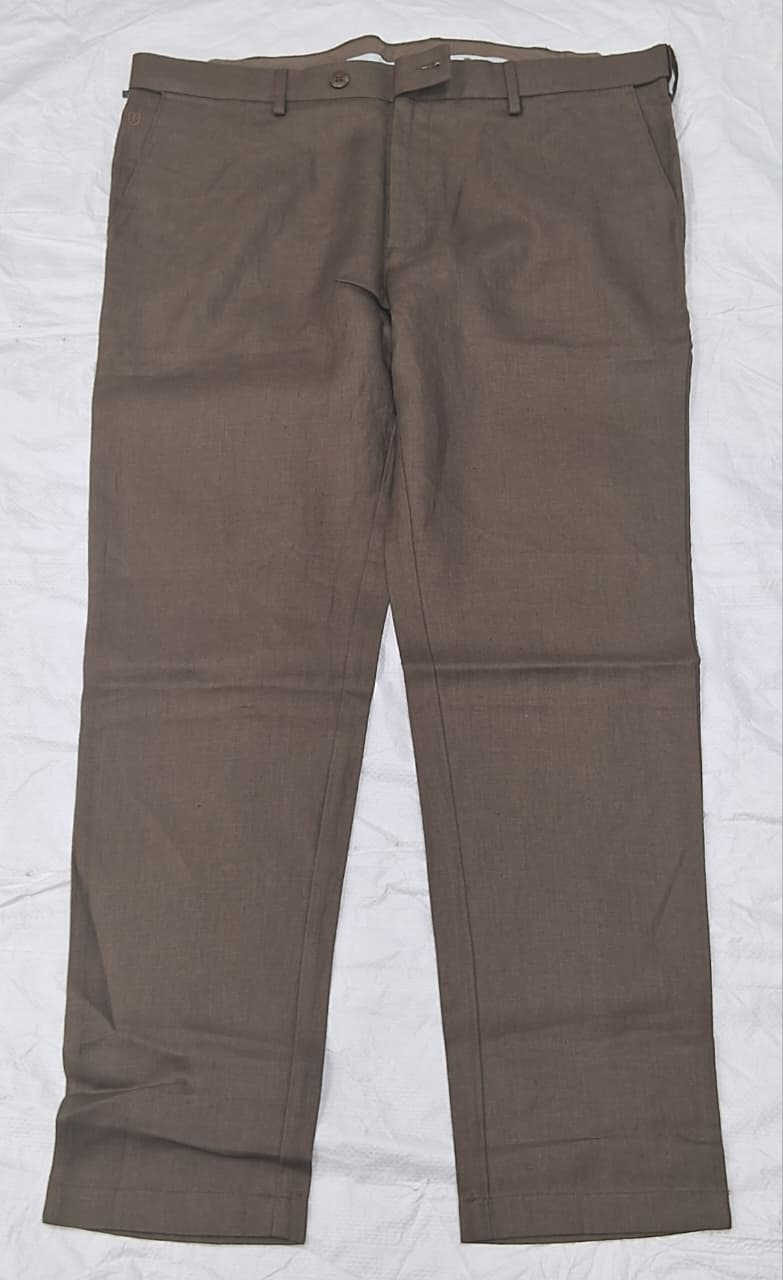
For most of tailoring's history, formal trousers were made from wool. In the decades after the Second World War, synthetic fibres, polyester above all, entered mainstream clothing. Blended with wool, viscose or cotton, they made trousers that resisted creasing, held a pressed line and were easier to wash: qualities that suited busy working lives.
More recently, small amounts of elastane have brought stretch to tailored trousers, enabling slimmer cuts that still move comfortably. Lightweight and open-weave cloths have made tailored trousers more practical in hot climates.
VII.
The formal trouser in India
In India, Western-style trousers spread through offices, schools and public institutions over the course of the twentieth century, and the combination of a shirt and trousers became the everyday uniform of urban professional life. Cities like Mumbai, with their commercial energy and dense working populations, have long relied on neighbourhood tailors and clothing stores to supply that uniform.
Indian formal dress has also kept its own vocabulary. Bandhgalas, Nehru jackets and kurtas sit alongside Western tailoring, and the formal trouser often bridges the two. The climate shapes choices too: lighter weights, breathable fibres and paler colours are a natural part of formal dressing in Mumbai.
VIII.
Timeless or temporary
The long history of the trouser offers a useful lesson. Fashionable extremes (the widest Oxford bag, the narrowest drainpipe, the lowest rise) date quickly. What survives is balance: a rise that suits the body, a leg that follows it without clinging, a length that meets the shoe cleanly and cloth that holds its line.
Building a modern formal wardrobe means taking something from both sides: the discipline of classic proportion, and the freedom of today's wider choice. Fit and proportion are the constant. Everything else can change with the season.